
Natasha McCandless
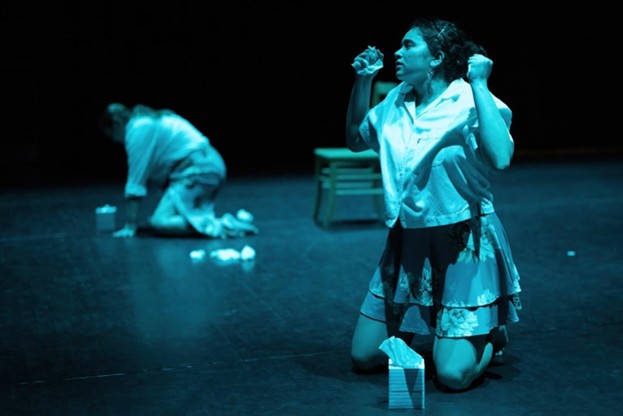
How can dance educators not only acknowledge but prioritize experiences of feeling in pedagogical spaces? This research question guided the creation of my 2022 choreographic piece Made of Water, an investigation of feeling in pedagogical space informed by Black feminist theory. As a dance educator, one of my core pedagogical principles is that students and teachers are grounded in two kinds of experiences: those within the body, and those related to perception. Acknowledging this in learning and rehearsal spaces bridges the mind/body and theory/practice binaries—especially when educators prioritize emotional experiences—and disrupts the normative, hierarchical systems that order language and cognition over the rich well of corporeal epistemes, and that order authority figures’ wants over student dancers’ needs. Rather than “desperately seek[ing] to recover ourselves, our feelings, our passions in some private place—after class,” bell hooks’s illustration of lonely pedagogical reflection, Made of Water sought to discover what can transpire when an authority figure shows up “wholehearted,” with an invitation for students to join.2bell hooks, Teaching to Transgress: Education as the Practice of Freedom (New York: Routledge, 1994), 192; italics added.
Made of Water premiered at the Fall 2022 Emerging Choreographers Showcase at the State University of New York at Buffalo to an audience consisting largely of family and friends of the dancers and choreographers involved, as well as students and faculty members from the Department of Theatre and Dance. The title came from the rupi kaur poem:
i am
made of water
of course i am emotional[.]3kaur, rupi, The Sun and Her Flowers (Kansas City, MO: Andrews McMeel, 2017), 110.
This short poem resonated with ideas that I had encountered while reading bell hooks’s Teaching to Transgress about being “whole in the classroom”—not pushing emotion aside—and it seemed to encapsulate the premise of the storytelling arc I hoped to achieve.4hooks, 193. Utilizing a cast of four undergraduate dancers (Tari Civerolo, Rebecca Leonard, Katy Maddalina, and Morgan Mahoney) Made of Water explored a specific emotional journey from grief to joy, using tissues as props. Our experiences throughout the rehearsal process facilitated collective learning about feeling within both pedagogical and performance spaces. We assembled the piece using a process-oriented choreographic approach; honoring my own emotional responses and physical experiences throughout allowed me to sensitively coach the dancers’ emotional intentions and touch-based interactions.
The Piece
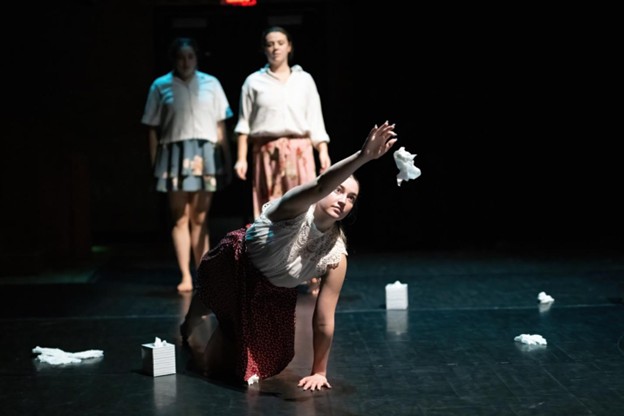
Reaching is a core, embodied theme of Made of Water, appearing in a number of variations throughout the piece. As seen in Image 2, Morgan (a white female dancer with blonde hair, wearing a lacy white shirt and burgundy floral skirt), kneeling, reaches to the full extension of her length, before dropping a tissue from her outstretched hand. We agreed as a company that the tissues symbolically represented memories. Watching the significant tension through her arm and the unwilling release of the tissue always generated a visceral feeling in me, as I remembered experiencing the gesture myself, in my own body, when I had conceptualized the piece.
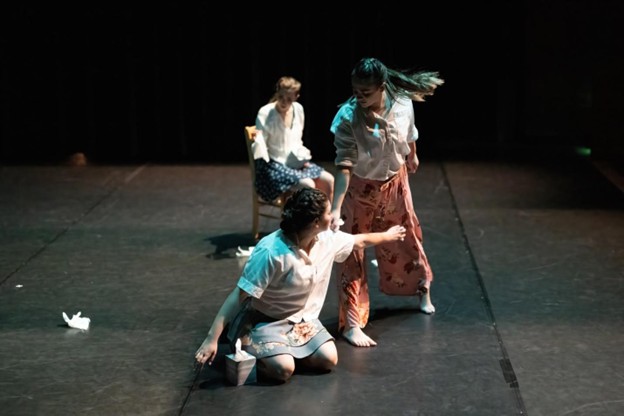
From there, the piece builds from the four dancers moving in isolation across four separate areas of the stage to the four dancers forming a community of connection and support. Rebecca and Tari are the first to connect. After offering tissues to each other, they reach out to comfort one another: Tari kneeling, reaching for Rebecca’s leg; Rebecca, standing, reaching for Tari’s shoulder (Image 3).
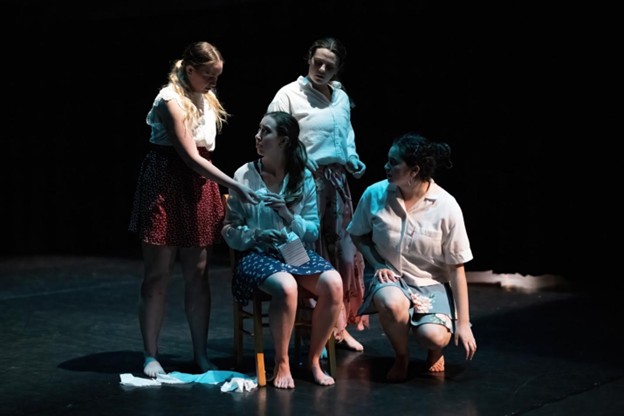
The full cast then comes together to comfort Katy (as seen in Image 4, a white female dancer with brown hair, wearing a white long-sleeve shirt and dark blue floral skirt), who had spent the first few minutes of the piece sitting alone in a chair dropping tissues to the floor. Though she was comparatively still, my choreographer’s eye was often drawn to her intense focus on her tissues—and my heart broke a little each time she dejectedly dropped one.
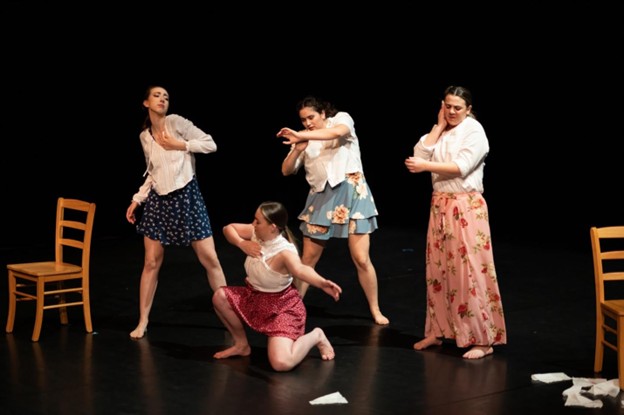
The cast’s relationship to the tissues shifts as the piece progresses: after using them to wipe and scrub at their own bodies, they begin to trace each other’s limbs gently. As Image 5 shows, Katy and Morgan wipe across their chests; Tari looks intently at where she dabs her wrist; and Rebecca scrubs at her cheek, eyes closed. This section of the piece is a structured improvisation, and I always enjoyed watching the dancers explore within the parameters we had set in rehearsal. In performance, it felt fresh every time.
As the dancers forge community and experience a changing relationship to the tissues—the slow, heavy drops of the beginning giving way to light, airy tosses—the emotional arc begins to bend toward joy. At the climax of the piece, my favorite moment, Tari, standing on a chair, smiles as she tosses tissues into the space. They float down softly around Katy, lying on her back, playfully making would-be snow angels amid the tissues scattered like snow on the black floor (Image 6).
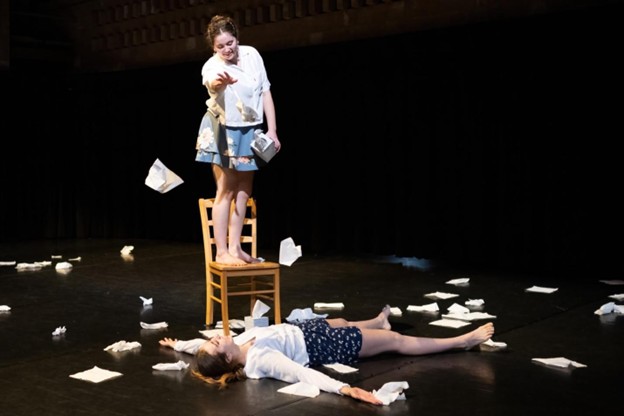
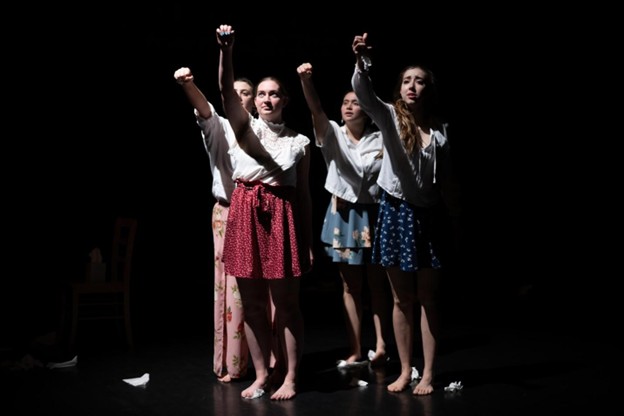
In the final moments of the piece, all four dancers, standing in a clump, simultaneously reach forward with their right hands, each clasping a final, unreleased tissue. This moment of collective reaching, ending in the unfurling of clenched fingers, is meant to be a cathartic release. It always felt like one to me.
Exploring Emotion
My project to reimagine the place of emotion in higher education classrooms and rehearsal spaces was inspired by bell hooks. As a white educator working with a homogenous population of primarily white dance students, I nonetheless found resonance in hooks’s critical pedagogical standpoint, which disrupts normalized and unnamed dynamics and hierarchies. In Teaching to Transgress, hooks examines the place of “eros” (emotion) in the classroom, arguing its importance not only in inviting passion and excitement from students and teachers, but also in fostering healthy teacher-student relationships. She writes: “[T]o call attention to the body is to betray the legacy of repression and denial that has been handed down to us by our professional elders.”5Ibid., 191. This sentiment echoes throughout other authors’ discussions of emotion in academic spaces, as well. Eve Kosofsky Sedgwick, for example, questions the traditional connection between emotion and libidinal drive by unpacking psychologist Silvan Tomkins’s separation of drive from affect.6Eve Kosofsky Sedgwick, Touching Feeling: Affect, Pedagogy, Performativity (Durham, NC: Duke University Press, 2003), 18–19. Moreover, dance scholar Susan Leigh Foster discusses the lack of kinesthetic knowledge in academic discourse, tying this deficiency specifically to (narrow-minded and misguided) ideas that conflate the body and sexuality. Citing John Martin, Foster describes how kinesthetic experience is connected to emotional experience, in turn echoing Sedgwick’s discussion of affect as embodied, and interwoven with cognition.7 Susan Leigh Foster, Choreographing Empathy: Kinesthesia in Performance (London: Routledge, 2011), 7. These writers contextualize emotion as felt, somatic, embodied experiences, framing feeling as a valuable way of knowing, an episteme. Incorporating this episteme into pedagogical settings—which tend to rely solely on language and cognition—allows students to draw from a larger range of experience as they learn.
I invited emotion and reflection on emotional experiences into the rehearsal room by purposefully positioning an emotional arc at the core of the piece. In conceptualizing Made of Water, I began by acknowledging and honoring my own emotional responses and physical experiences navigating grief, readying myself to bring this knowledge into the choreographic process. With this preparation in hand, I could share performance strategies and craft experiences with the dance students without verbally sharing the specifics of my personal circumstances. Rather, coaching and group conversations guided our initial movement generation, and carried over into the longer-term rehearsal process.
Cultivating ensemble rapport was another strategy that guided our process. The cast of Made of Water was the same group of four dancers who had performed in a piece I had created the previous semester. Therefore, they all were already familiar with me, my choreographic process, and each other. This preexisting collaborative energy provided a strong foundation for our continued work together: a heightened level of mutual trust and comfort, built over time, that enhanced our ability to explore the piece’s thematic depths. Throughout the rehearsal process, I continued to find ways to unify the ensemble. For example, I asked them about their days, their semesters, their classes as they warmed up before each session. In her book Feltness: Research-Creation, Socially Engaged Art, and Affective Pedagogy, Stephanie Springgay states that “the artist-pedagogue does not mold students into a work of art, as if the students simply become raw materials separate from the pedagogical event.”8Stephanie Springgay, Feltness: Research-Creation, Socially Engaged Art, and Affective Pedagogies (Durham, NC: Duke University Press, 2022), 4. Attending to dance students as people demonstrates care about their lives both in- and outside the rehearsal space. This strategy sees dancers’ contributions as more than “raw material,” and instead activates their artistic roles as participants and collaborators. Building rapport takes time. In this case, I chose to cast dancers with existing relationships. But in even shorter rehearsal processes (like for musical theatre), it is still possible to implement small shifts in how performers engage with one another in order to solidify the ensemble. A holistic sense of care for all participants’ well-being creates common ground, the ground on which effective teaching happens.
From the start I was explicit with the performers about the thematic goals of the piece. We discussed why we made certain staging choices, in particular the transition from individuals in isolation to a community of support. Even when intention felt blurry (for example, what did the reaching gesture come to represent in the piece’s final tableau?), we worked together to discuss the physical sensations the dancers were experiencing in order to craft meaning. One strategy I devised was an “acting the dance” exercise, inspired by voice teachers who have their student actors speak song lyrics as monologues in order for them to gain richer understanding of their characters’ emotional journeys across their songs. No one’s favorite exercise (certainly not mine), it nevertheless almost always provides new perspective on a character’s emotional experience. Over two rehearsals, the cast and I talked through every section of the piece and discussed how they felt while performing it, incorporating feedback from what I saw—and felt—as a spectator. Each wrote down their own thoughts before I asked volunteers to share. This exercise helped to align the ensemble’s overall goals for the piece, while simultaneously discovering opportunities for individual intention in performance. Although I never required them to share their private thoughts as performers in the piece, I encouraged them to discover clear personal connections to the material in order to enhance the clarity, honesty, and intentionality of their work. One of the dancers later shared: “I was able to find nuance between the different, changing emotions instead of sitting in one emotional expression the whole time . . . . In one of our last rehearsals, I was so moved by the dance that it brought me to tears.”9Quotations from dancers and audience members were recorded via interviews with the author, on a voluntary basis.
Although such emotional engagement tended to occur at the individual level, in the end, the dancers formed an intimate emotional community. For instance, it was together, collaboratively, that they agreed on the symbolism of the tissues. One dancer reflected, “It was generally helpful that we decided on a specific meaning of the tissues as memories, so I wasn’t going through some ambiguous journey between emotions.” By foregrounding emotion and sensation throughout our work together, I bolstered my dancers’ sense of artistic agency, allowing them to decide for themselves how to participate in and what exactly to contribute to the piece.
Welcoming emotion into the process—both in rehearsal and in performance—created deep emotional impact for our audiences as well. The onstage catharsis invited them to participate and respond with their own emotions. For example, a family friend of mine who has been sober for more than twelve years was profoundly moved watching a video of our dress rehearsal, comparing the piece to “the dance version of recovery via my [support group] fellowship.”
Experiencing Touch
The piece’s emotional arc—and the dancers’ experiences within it—may have fueled the primary meaning-making and thematic impact of Made of Water, but the dancers’ sensory interactions with the prop tissues, and with each other, provided further semiotic opportunities. How touch operates in pedagogical spaces can define the power dynamics at play. Olivia Michiko Gagnon, for example, describes touch as “a fraught mode of encounter haunted by the racial violences of transatlantic slavery,” particularly due to the treatment of “the enslaved as racial objects/nonsubjects.” Sedgwick claims that touch troubles dualistic understandings of agency and passivity, but Gagnon questions this perspective, highlighting the “unidirectionality” of touch in hierarchical contexts, such as a “masterful subject who touches toward an inanimate object that is touched.”10Olivia Michiko Gagnon, “Tender Archives and the Closeness of Cheryl Sim’s The Thomas Wang Project,” Women & Performance 31, no. 1 (December 2021): 14, https://doi.org/10.1080/0740770x.2021.1985269. For clarity, the “inanimate object” Gagnon mentions here is an enslaved person—what Hortense Spillers designates as “flesh,” rather than a “body.” Gagnon cites Hortense Spillers’s “Mama’s Baby, Papa’s Maybe” and her differentiation between body and flesh: the body has discursive and social properties, while flesh is purely physical. Pedagogical settings are necessarily hierarchical, since the teacher (or choreographer) holds authority over the student (or dancer); therefore, questions about the power dynamics and ethics of touch abound. In the “Best Practices” workshop of the consulting group Theatrical Intimacy Education, theatre director and intimacy educator Kim Shively outlines the importance of considering the historical shift in theatrical production from collaborative practice to capitalist hierarchy, in which actors are now viewed as subservient to the authority of a director. Shively states emphatically: “‘No’ is not a word that has been allocated to actors. ‘No’ is not a word that has been allocated to students.”11Kim Shively, “Best Practices” (online workshop, Theatrical Intimacy Education, December 18, 2023). All workshop quotations appear here as transcribed by the author. Arts philosopher Erin Manning provides further points for care and consideration in her book Politics of Touch: Sense, Movement, Sovereignty. There she describes touch as “plural”: “To touch is always to touch something, someone.” But touch is also “an ethical discourse because I cannot touch you without being responsible for doing the touching . . . . For touch must always indicate its source.” 12Erin Manning, Politics of Touch: Sense, Movement, Sovereignty (Minneapolis: University of Minnesota Press, 2007), 12, 9. Consequently, teachers and choreographers, in the roles of traditional authority figures, are responsible for touch within their pedagogical domains. They can work to disrupt notions of hierarchy and reinforce the agency of their students by providing safe and ethical learning experiences centering touch, wherein students can learn to advocate for themselves as empowered subjects.
Working with props provided the performers an opportunity to integrate tactile experience throughout the piece. The tissues afforded the dancers a safe way to interact with (inanimate) objects before sharing touch with other bodies onstage.13Posthumanism posits movement beyond human-centric views of space and, in fact, views all matter as relational. In this instance, however, the tissues are fixedly non-sentient objects, in contrast to Spillers’s designation of “flesh”: a person considered as an object, and Gagnon’s point about hierarchy in which a “masterful subject” touches toward the “inanimate object” of flesh: an aware, thinking, feeling being. Since one of the major themes of Made of Water was holding on to or letting go of past experiences—represented by the dancers’ manipulation of the tissues—the performers had to handle these material items strategically and intentionally, exacting a refined sense of awareness. Reluctance to let the tissues go at the beginning of the piece contrasted markedly with their joyous release into the air at the end. One dancer assessed that touch and sensation played a part here “more so than in any other piece I’ve been in,” explaining that interacting physically with the tissues shaped her embodied experience. “[I]magining different textures for the tissues was useful in determining my movement,” she recalled. These physical interactions shaped the performance: the close physical proximity, the dancers comforting one another by gently touching and wiping one another’s limbs with tissues contributed created a community onstage. The intimate connections the four dancers forged, and the various ways they touched the tissues in doing so: dropping, tossing, dabbing, wiping, scrubbing, helped communicate the message of the piece.
Encouraging Choice
Lately in academic discourse the notion of consent demands pedagogical attention, particularly in the context of theatre and dance classrooms. Writer and activist adrienne maree brown defines consent as “saying yes on your own terms. Giving permission or agreement for something to happen.”14adrienne maree brown, Pleasure Activism: The Politics of Feeling Good (Chico, CA: AK Press, 2019), 196. She explains further that cultivating spaces where actors/dancers/students do not feel empowered to say “no” means that they may not be able to create on their own terms. Kim Shively has detailed how hierarchies of power can activate our survival senses, including fight, flight, freeze, and fawn responses, and argues that saying “yes” (a “fawn” response) is taught as a survival strategy within formal education systems. Survival, however, is not consent, and she makes clear that “we cannot engage in consent if we are in survival mode.”15Shively. On this project, my view of consent was further refined by Emily A. Owens, who frames consent within a history of legality based on contract and transaction, influenced by a sense of privilege based on specifically white male identity. While Owens refers specifically to consent in sexual contexts, her ideas apply to consent in classroom and rehearsal settings, which are also transactional spaces.16Emily A Owens, “Keyword 7: Consent,” Differences 30, no. 1 (2019): 148–56, https://doi.org/10.1215/10407391-7481316. Here she is interested in sexually violent contexts specifically.
Students must gain practice identifying and voicing their boundaries regarding touch in safe spaces as part of their university training, so that they will be prepared to confront ethical challenges in professional environments. At a workshop titled “Consent in Academia” run by the organization Intimacy Directors & Coordinators, intimacy director Francesca Betancourt highlighted the importance of educators actively considering power dynamics, and encouraged participants to create spaces in which students do not just take care of themselves, but learn how to care for themselves. For example, starting class or rehearsal with a body scan—a mindfulness practice directing participants’ attention to the various areas of their bodies—can help students connect to their bodies and emotions. It is important to me to teach intentional strategies that can help students develop fluency articulating and applying feeling and sensation when it comes to their art.
Training students to acknowledge their bodies and to integrate bodily knowledge with other forms of learning and art-making teaches them to reach beyond the traditional dualistic, logocentric education paradigms. As embodied beings, students need skills beyond isolated cognitive and verbal abilities to function effectively in the world. Educating young dancers that they have options for how to engage with touch as a modality is one of the first steps in learning when and how to set boundaries as participants in choreographic processes. Something as simple as asking “Is it ok for Tari to touch your leg right above your knee?” and working with the student’s response, whatever it is—“yes,” “no,” “maybe,” “I don’t know”—models care and reminds students crucially that they have choices.
Conclusion
“To restore passion to the classroom,” bell hooks writes, “or to excite it in classrooms where it has never been, professors must find again the place of eros within ourselves and together allow the mind and body to feel and know desire.”17hooks, 199. In specifically calling for a reintegration of mind and body, hooks works against the traditional, hierarchical values of Western dualism baked into in American educational systems. Answering her call, we must explore and prioritize strategies that address feeling and sensation in classroom and rehearsal settings; doing so supports not only students’ artistic and academic success but their personal wellness, too.
Moving forward, I strive to continue expanding my toolbox as a teacher and choreographer, searching out new ways to cultivate wellness for my students. I seek not merely to include the body and perception in the learning spaces entrusted to me, but to celebrate their usefulness there. Additionally, I seek to disrupt the formal authority of teachers over their students by prioritizing touch and emotion, encouraging individual agency to emerge. Students need to be prepared for a variety of settings that will require them to choose how to engage with touch—not only dance rehearsals, but also in day-to-day life—and I remain committed to developing further strategies for promoting holistic care across them, beginning with university classroom spaces.
- 1All photographs of Made of Water were taken by Ken Smith, provided courtesy of the University at Buffalo Department of Theatre and Dance. ↩︎
- 2bell hooks, Teaching to Transgress: Education as the Practice of Freedom (New York: Routledge, 1994), 192; italics added. ↩︎
- 3kaur, rupi, The Sun and Her Flowers (Kansas City, MO: Andrews McMeel, 2017), 110. ↩︎
- 4hooks, 193. ↩︎
- 5Ibid., 191. ↩︎
- 6Eve Kosofsky Sedgwick, Touching Feeling: Affect, Pedagogy, Performativity (Durham, NC: Duke University Press, 2003), 18–19. ↩︎
- 7Susan Leigh Foster, Choreographing Empathy: Kinesthesia in Performance (London: Routledge, 2011), 7. ↩︎
- 8Stephanie Springgay, Feltness: Research-Creation, Socially Engaged Art, and Affective Pedagogies (Durham, NC: Duke University Press, 2022), 4. ↩︎
- 9Quotations from dancers and audience members were recorded via interviews with the author, on a voluntary basis. ↩︎
- 10Olivia Michiko Gagnon, “Tender Archives and the Closeness of Cheryl Sim’s The Thomas Wang Project,” Women & Performance 31, no. 1 (December 2021): 14, https://doi.org/10.1080/0740770x.2021.1985269. For clarity, the “inanimate object” Gagnon mentions here is an enslaved person—what Hortense Spillers designates as “flesh,” rather than a “body.” ↩︎
- 11Kim Shively, “Best Practices” (online workshop, Theatrical Intimacy Education, December 18, 2023). All workshop quotations appear here as transcribed by the author. ↩︎
- 12Erin Manning, Politics of Touch: Sense, Movement, Sovereignty (Minneapolis: University of Minnesota Press, 2007), 12, 9. ↩︎
- 13Posthumanism posits movement beyond human-centric views of space and, in fact, views all matter as relational. In this instance, however, the tissues are fixedly non-sentient objects, in contrast to Spillers’s designation of “flesh”: a person considered as an object, and Gagnon’s point about hierarchy in which a “masterful subject” touches toward the “inanimate object” of flesh: an aware, thinking, feeling being. ↩︎
- 14adrienne maree brown, Pleasure Activism: The Politics of Feeling Good (Chico, CA: AK Press, 2019), 196. ↩︎
- 15Shively. ↩︎
- 16Emily A Owens, “Keyword 7: Consent,” Differences 30, no. 1 (2019): 148–56, https://doi.org/10.1215/10407391-7481316. Here she is interested in sexually violent contexts specifically. ↩︎
- 17hooks, 199. ↩︎