
Frederick D. Miller
University of Pittsburgh
“It’s a Scandal! It’s an Outrage!”: An Introduction
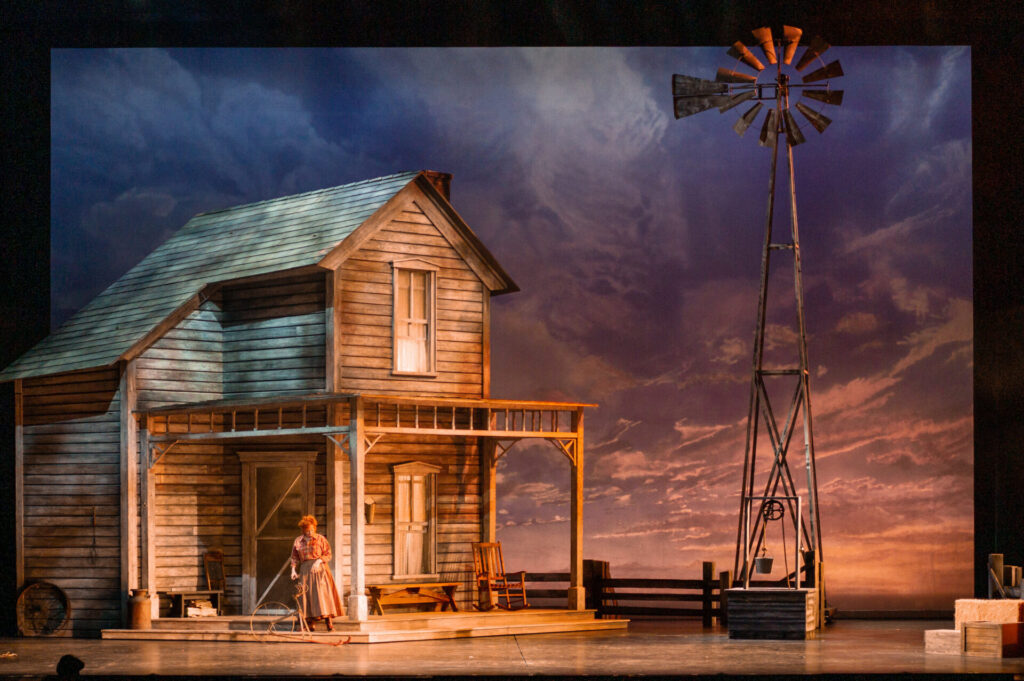
In 2019, director Daniel Fish’s provocative staging of the classic American musical Oklahoma! opened at the Circle in the Square Theatre on Broadway. Staged in a deep thrust, Fish’s version challenged audiences where Oklahoma!’s March 1943 premiere on the St. James Theatre’s proscenium stage had delighted them. Then, most audiences were quickly captivated by Richard Rodgers and Oscar Hammerstein II’s musicalization of Lynn Riggs’s 1931 play Green Grow the Lilacs. Like its source material, Oklahoma! roots its story in Indian Territory at the turn of the twentieth century, as cowboy Curly courts farmgirl Laurey. Scenic designer Lemuel Ayers’s painted backdrops of blue skies, pure white clouds, and acres of rolling farmland coaxed theatregoers with a mythic American past, calming anxieties for many as the country found itself in the midst of World War II.
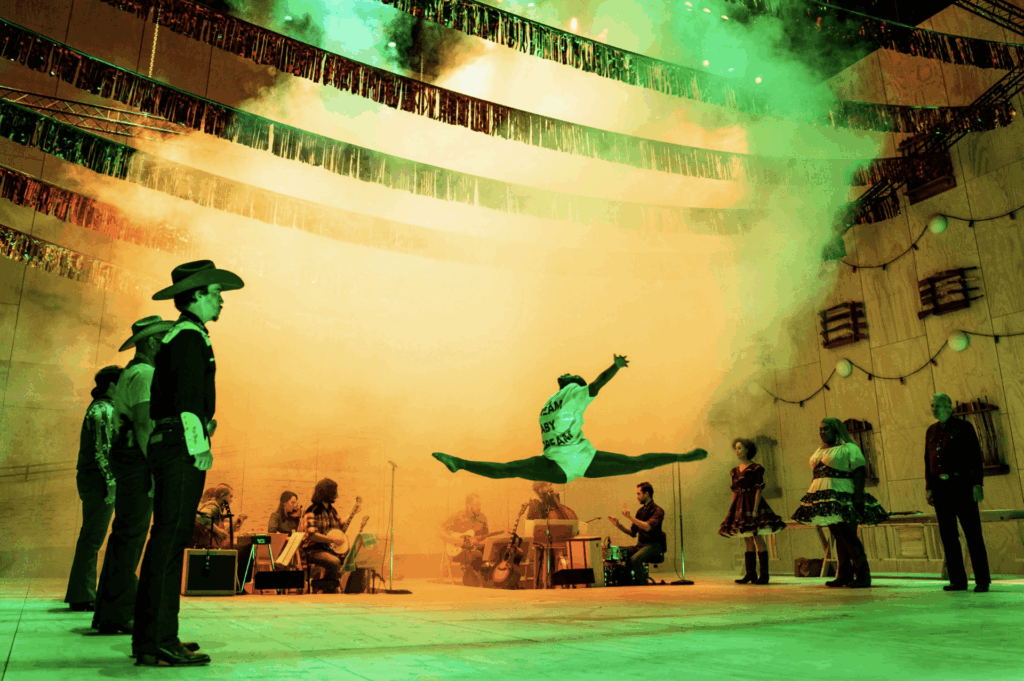
More than seventy-five years after Oklahoma!’s debut, Fish’s revival departed from this mise en scène, discarding period costumes and scenery, transporting the musical to the present day. As described by New York Times theatre critic Ben Brantley, Laura Jellinek’s set suggested “a small town community center that might double as a polling station, decorated with festive banners, colored lights—and a full arsenal of guns on the walls.”1Ben Brantley, “Review: A Smashing ‘Oklahoma!’ is Reborn in the Land of Id,” New York Times, April 7, 2019, https://www.nytimes.com/2019/04/07/theater/oklahoma-review.html. Jellinek’s design returned audiences indoors, where Riggs’s play largely takes place, and away from the outdoor spaces that Hammerstein had scripted to allow for “greater freedom of action and movement.”2Tim Carter, Oklahoma!: The Making of an American Musical, rev. ed. (New York: Oxford University Press, 2020), 88. Fish’s Oklahoma! insisted upon intimacy, taking audiences behind closed doors, confining both actors and audience members, in order to present Oklahoma! “in a way that would invite audiences to watch this story about community in early twentieth[-]century America and find reflections of communities in the United States today.”3Christopher Bannow, “Surviving in the States: Audience Rejection on the Road with Oklahoma!,” HowlRound (blog), April 3, 2023, https://howlround.com/surviving-states-audience-rejection-road-oklahoma. Clearly, the director intended to push audiences to reconsider Oklahoma!’s relationship to its source material, its position within the musical theatre canon, and its parallels with the contemporary moment.
Circle in the Square’s inclination toward intimacy is at once implied by its capacity of fewer than 800 seats, but such intimacy is also embedded within its history.4Sources report conflicting numbers for Circle in the Square’s audience capacity due to the theater’s flexible seating configuration. Founded in 1951, the Circle in the Square Theatre was initially housed in Sheridan Square in New York City’s West Village. The original venue’s status as a former nightclub complicated the company’s acquisition of a theatre license. Instead, it procured a cabaret license, requiring the company’s first production—Howard Richardson and William Berney’s Dark of the Moon (1951)—to serve “cookies and punch . . . in order for the show to go on.”5Jennifer Ashley Tepper, The Untold Stories of Broadway, vol. 2 (New York: Dress Circle, 2014), 137. Eating together establishes community with and among an audience, a rite Fish’s production inadvertently reprised by serving cornbread and chili to audience members onstage during Oklahoma!’s intermission. Indeed, while Fish’s directing choices sought new degrees of closeness within the action of Rodgers and Hammerstein’s text, the space the production inhabited amplified its intimacy as well.
At Circle in the Square (in its current home on West 50th Street, where it’s been located since 1972) Jellinek’s immersive design enveloped the audience: house lights stayed on for much of the play’s duration; performers entered and exited via audience aisleways; and chili simmered in crock pots onstage throughout the entire first act. Angela Sweigart-Gallagher and Aaron C. Thomas’s 2015 Theatre Topics article suggests that “dramaturgies of place” are the effects that “a specific location has on the shapes and rhythms of a theatrical performance.”6Angela Sweigart-Gallagher and Aaron C. Thomas, “The Location’s the Thing: Endstation Theatre and Dramaturgies of Place,” Theatre Topics 25, no. 1 (March 2015): 27. I extend their thinking here to consider the relationship between a theatre’s auditorium and its stage, analyzing how dramaturgies of space work in tandem as one cohesive unit in considering audience reception of a performance. Therefore, I argue here that the architecture of the Circle in the Square Theatre accentuated Fish’s creative desires, enabling a particular kind of intimacy and engagement with Oklahoma! and its themes. This same intentionality was not and could not be replicated in the reconfigured staging for its 2021 national tour.
While critics generally favored the revival on Broadway, where it received the 2019 Tony Award for Best Revival of a Musical, its subsequent tour was a different story. In her January 2022 review of the tour in Chicago, critic Hedy Weiss labeled the production a “travesty of a mockery of a sham . . . [and] a warped and destructive version of its source.”7Hedy Weiss, “National Touring Production of ‘Oklahoma!’ Wreaks Havoc on a Musical Theater Classic,” WWTW, January 13, 2022, https://news.wttw.com/2022/01/13/national-touring-production-oklahoma-wreaks-havoc-musical-theater-classic. I read this critique alongside other audience testimonies, ranging from established critics to amateur bloggers to casual theatregoers, to ensure that Weiss’s displeasure with Fish’s reimagining was not an utter anomaly. In fact, Christopher Bannow, the actor who played antagonist Jud Fry on tour, expanded upon these bad affects in a 2023 essay published on HowlRound:
We had walkouts, of course, but also snickering, jeering, dumbfounded faces, searing reviews, refunds demanded, boos, audience members standing with both thumbs pointed down, vomiting in the balcony, sleeping, Facebook posts, Instagram messages, and emails. 8Bannow.
Given the production’s successful Broadway run, how could this have happened?
“Everything’s (Not) Up to Date in [Minneapolis]”: Oklahoma! Hits the Road
Well before the revival’s Broadway bow, in 2007 Daniel Fish worked with students at Bard College to present Oklahoma! as a work of intimate dinner theatre. When Fish restaged that production in 2015 at Bard’s SummerScape festival it retained its intimacy, again seating audience members at picnic tables and serving cornbread and chili. The 2018 Off-Broadway run at St. Ann’s Warehouse in Brooklyn replicated Fish’s mise en scène, with Jesse Green of the New York Times praising the conceit: “[T]he whole thing feels much more intimate because of the context.”9Jesse Green and Ben Brantley, “Review: There’s a Dark, Golden Haze in this Reclaimed ‘Oklahoma!,’” New York Times, October 7, 2018, https://www.nytimes.com/2018/10/07/theater/oklahoma-review.html. The production transferred to Circle in the Square in April 2019, where it continued to receive high praise from both critics and audiences alike. During the length of its run, Oklahoma! averaged an audience capacity of 93%. In May 2019 producers announced a national tour, the first Broadway production of Oklahoma! to tour the US since 1981, creating the first opportunity many parts of the country would have to experience the classic musical in a professional staging.10Logan Culwell-Block, “Oklahoma! Revival to Embark on National Tour,” Playbill.com, May 13, 2019, https://playbill.com/article/oklahoma-revival-to-embark-on-national-tour. The tour began performances following a COVID-19 pandemic postponement in November 2021 at the Orpheum Theatre in Minneapolis (instead of the previously announced Civic Center Music Hall in Oklahoma City).
Minneapolis theatre blogger Alex Lauer titled his review “Broadway’s Spellbinding Oklahoma! is Dead on Arrival in Minneapolis.” A self-proclaimed fan of Daniel Fish’s reimagining, Lauer expressed his disappointment with changes made for the production’s tour, noting the loss of intimacy he had felt on Broadway in the 2,600-seat Orpheum Theater:
The biggest failure is not a result of Fish’s avant-garde interpretation or the performance of the cast or seven-piece band. It was the sound, or lack of thereof. Sitting in the back row in the center of the main floor, I couldn’t hear half of the words uttered on stage, whether they were talking or singing, a problem that was immediately echoed at intermission by my six companions that night and, later, in comments online. 11Alex Lauer, “Review: Broadway’s Spellbinding ‘Oklahoma!’ Is Dead on Arrival in Minneapolis,” One Fan Show (blog), November 13, 2021, https://onefanshow.com/2021/11/13/review-broadways-spellbinding-oklahoma-is-dead-on-arrival-in-minneapolis.
The loss of sound, Lauer theorized, contributed to the collective negative reaction the production generated. While the hushed tones of actors onstage at Circle in the Square lent themselves to the production’s dramaturgy, any attempt to replicate them in the massive Orpheum inherently resulted in failed auditory reception. The text itself was potentially the only identifying residue for audiences who might otherwise have found this Oklahoma! unrecognizable. Problems with the sound design made Fish’s staging alienating rather than intimate, even for the most open-minded of audience members. Bannow implies this in his essay, where he echoes earlier sentiments by Fish, suggesting that national tours offer benefits to those outside of New York City, “inviting more audiences into the conversation” [italics original].12Bannow. If, as Lauer suggests, the sound design of the tour denied such an entrance into the world of the play, no such conversation could occur.
In his review, Lauer continued to address changes to the production’s dramaturgy of space and noted what he characterized as pared-down performances by its actors: He branded actor Sean Grandillo’s “Oh, What a Beautiful Mornin’” as a “passing ditty,” accused Hennessy Winkler and Benj Mirman as Will Parker and Ali Hakim of leaving “silence in their wake,” and labeled Sis Thee Doll’s performance of “I Cain’t Say No” as evidence of the creative team’s decision to cut down choreography rather than to expand it for a larger stage.13Lauer. For Lauer, the best parts of the tour were indeed holdovers from the Broadway production, including Gabrielle Hamilton’s solo dream ballet at the top of the second act as well as Bannow’s performance of “Lonely Room” (he had understudied the role of Jud in New York). Still, these moments occurred well after many audience members, like Lauer, had already reached their verdicts on the production.
“All ‘er Nuthin’”: Disrupting Nostalgia in Pittsburgh
Fewer than three months after its Minneapolis premiere, Oklahoma! arrived in Pittsburgh, Pennsylvania, in early January 2022, to play the even larger 2,800-seat Benedum Center for a six-day run. The PNC Broadway in Pittsburgh series, described in marketing materials as “bringing the best, award-winning Broadway shows to the historic Benedum Center,” is part of the Pittsburgh Cultural Trust’s annual lineup of arts offerings, featuring a wide variety of shows ranging from new works to classics. Fish’s Oklahoma! appeared in its 2021–2022 season alongside national tours of Hamilton (2015), Pretty Woman (2018), and Summer: The Donna Summer Musical (2018), shows whose reputations largely preceded them due to prior commercial success or widespread fondness for their underlying intellectual property. The decision to program Fish’s Oklahoma! for the PNC Broadway series likely relied on assumed name recognition, signifying even to those unfamiliar with the musical a slice of uncontestable Americana.
Earlier, in June 2019, the Pittsburgh Civic Light Opera (CLO) had mounted the musical as part of its summer season, also at the Benedum Center, marking the company’s eighth production of the Rodgers and Hammerstein warhorse in its seventy-three-year history. (For Pittsburghers, Oklahoma! holds additional sentimental value: Shirley Jones, who played Laurey in the 1955 film adaptation, is a Pittsburgh native. In the 2007 CLO staging, Jones returned to Oklahoma! in the role of Aunt Eller.) In a now-archived page on its website, the CLO described its production of Oklahoma! as the “Classic Version,” likely anticipating audience anxieties about whether or not the CLO would attempt a radical reimagining like the one then playing on Broadway.14Pittsburgh Civic Light Opera, “Rodgers & Hammerstein’s OKLAHOMA!,” accessed February 28, 2025, https://www.pittsburghclo.org/shows/oklahoma. After all, Fish’s Oklahoma! had just that same month performed on the CBS Tony Awards broadcast to audiences across the country. In her review of the CLO production for onStage Pittsburgh Jade Goodes aired and assuaged these anxieties, writing:
You may be familiar with the current production on Broadway that recently won Best Revival at the Tony Awards. The revival is set in modern[-]day time and reflects the current state of our country. The CLO takes on the “classic” production[,] however, which is the more wildly [sic] known version of the musical. So while the CLO’s production may not be as dark or as gritty as the revival, they still make Oklahoma! an enjoyable experience and manage to bring a new life to the quintessential American musical.15Jade Goodes, “The Crackling Charm of Pittsburgh CLO’s ‘Oklahoma!,” onStage Pittsburgh, June 25, 2019, https://onstagepittsburgh.com/2019/06/25/the-crackling-charm-of-pittsburgh-clos-oklahoma.
Goodes’s review praises the overall production, especially Michael Schweikardt’s scenic design. Production photos on the CLO website featuring Schweikardt’s and Haley Dee Tynes’s respective scenic and costume designs recalled the aesthetic of the original 1943 production: women in vibrant, gingham dresses dancing alongside men donning cowboy hats and boots, against a backdrop of a farmhouse and a wind pump. Seemingly conflating the musical’s text with its original production aesthetic, Goode notes that the CLO’s “classic” take made for an enjoyable nostalgia-fest.
Oklahoma!’s return to the same Pittsburgh venue fewer than three years after the CLO’s production did not inspire the same nostalgia. Ahead of the Pittsburgh tour stop, the Pittsburgh Post-Gazette interviewed Bannow for his take on the staging. The headline “Reimagined ‘Oklahoma!’ Coming to Benedum” anticipated Bannow’s optimism about the musical’s potential to reach Pittsburgh audiences already familiar with the material. Once again, Bannow voiced his belief that the production would “jumpstart so many conversations about the interpretation.”16Joshua Axelrod, “Reimagined ‘Oklahoma!’ Coming to Benedum,” Pittsburgh Post-Gazette, January 4, 2022, https://www.post-gazette.com/ae/theater-dance/2022/01/04/broadway-musical-oklahoma-benedum-center-gabriele-hamilton/stories/202201040002. A casual theatregoer like Melissa Karidis Fleming, however, felt uncertain about how to find her way into that conversation, which clouded her reception of the musical overall. Despite sitting within the first few rows of the Benedum Center’s orchestra section, she felt disconnected from the action onstage. Initially unaware of how Fish had staged the musical at Circle in the Square, Karidis Fleming was surprised to learn how the Broadway theatre’s three-quarter thrust generated intimacy between the performers and their audience, to say nothing of the actors’ infiltration into the audience there. With this insight, she hypothesized: “I think that would make a difference in how you view it. . . . If you’re seeing [others], it’s almost comforting. I don’t like feeling like it’s a lot and feeling alone.”17Melissa Karidis Fleming, interview by the author, February 8, 2025. The anxiety caused by the pronounced separation between stage and house informed Karidis Fleming’s decision to leave at intermission with her husband, stifling any potential further engagement with Fish’s hoped-for “conversation.”
“We Know We Belong to the Land [and Sea]: Oklahoma! and Once on This Island
Fish’s Oklahoma! was not the first revival of a musical that played Circle in the Square but reconfigured its staging for a proscenium-style national tour. In 2019 Stephen Flaherty and Lynn Ahrens’s Afro-Caribbean take on The Little Mermaid, Once on This Island (1990), began touring, following its 2017 Tony Award-winning run at Circle in the Square. Just as Fish would do, Once on This Island director Michael Arden revisited his staging ahead of the tour’s launch:
At each performance, there will be onstage seating, creating a unique experience within the footprint of every theatre we play […] Audiences will be invited to put their feet in the sand and surround our company, becoming part of the show. It’s our goal to give all audiences a unique perspective of the communal nature of what theatre can be…18Quoted in Andrew Gans, “Tamyra Gray, Phillip Boykin, More Star in National Tour of Once On This Island Beginning October 12,” Playbill.com, October 12, 2019, https://playbill.com/article/tamyra-gray-phillip-boykin-more-star-in-national-tour-of-once-on-this-island-beginning-october-12.
Arden’s sentiments echo Fish’s vision for Oklahoma!, drawing on themes of community and highlighting the importance of immersion into the story. In this way, Arden and Fish both demonstrate understanding of the American musical’s tendency to depict creation, maintenance, and/or disillusion of community, even as they manifest this understanding differently. For example, Arden strove to maintain the intimacy of Circle in the Square by allowing audience members to sit alongside actors within the confines of the proscenium arches standard in most US touring houses. Fish did not, opting instead for a traditional divide between stage and auditorium.
Arden possessed a crucial advantage here, however. The cultural legacy of Oklahoma! is comparatively fixed. By sheer dint of Oklahoma!’s age, audiences are more likely to have foreknowledge of it than they are to have of Once on This Island, foreknowledge gained through countless school and community productions, cast albums, or the 1955 film adaptation. These examples recall Marvin Carlson’s concept of “ghosting,” which concerns the expectations audiences carry with them born of the sum total of their previous theatergoing experiences.19Marvin Carlson, The Haunted Stage: The Theatre as Memory Machine (Ann Arbor, MI: University of Michigan Press, 2001), 7. Audiences at Oklahoma!, in general, expect something reminiscent of Lemuel Ayers’s frontier-flavored scenic designs—not Laura Jellinek’s multipurpose, enclosed space. As of March 2025, the licensing company Music Theatre International’s website lists only twenty-eight upcoming stock and amateur productions of Once on This Island, whereas the Concord Theatricals website lists seventy-three comparable mountings of Oklahoma!20Music Theatre International reports upcoming licensed stock and amateur productions of Once on This Island, updated in real time, at https://www.mtishows.com/externalmap/1309. Concord Theatricals (now the parent company of Music Theatre International) does the same for Oklahoma! at https://www.concordtheatricals.com/p/44839/rodgers-hammersteins-oklahoma#now-playing. Without so many preconceptions about Once on This Island, audiences might have been more willing to view Arden’s production with fresh eyes. For Fish’s Oklahoma!, though, there was far greater chance from the start for scandal and outrage.
“[It Doesn’t Have to Be a] Lonely Room”: A Conclusion
At the 2019 Tony Awards, the company of the Oklahoma! revival performed a medley of songs beginning with Ali Stroker performing a cut of “I Cain’t Say No,” first appearing on the passerelle protruding from the Radio City Music Hall stage. Audience members seated on both sides of the catwalk shifted their bodies to view her performance. When Stroker concluded, she joined her fellow company members on the main stage as the medley segued into the show’s title song. Seated along the upstage wall were more audience members. Actors split their engagement between the television cameras, the spectators in the auditorium, and the spectators onstage, sharing their anthem in every direction. Despite Radio City’s proscenium stage, Oklahoma!’s Tony Awards performance bred the same sort of intimacy it fostered at Circle in the Square. (Two years earlier the company of the 2017 Once on This Island revival offered a similar performance on the same stage, also seating audience members among the onstage performers.)
Like national tours, the Tony Awards present an opportunity for Broadway shows to reach audiences beyond New York City. For viewers outside of New York—like those in Minneapolis and Pittsburgh—it is possible that Oklahoma!’s Tony Awards performance was the first time they saw or even heard of Daniel Fish’s reconceived production. Even viewers with no context for Fish’s directorial approach might suspect that it was not what a conventional staging of the musical “should be.” The diversity on display was a clear departure from the original production’s all-white, able-bodied cast, drawing attention to the “violence and white supremacy inherent in the play,” as Charlotte M. Canning has observed.21Charlotte M. Canning, Theatre & The USA (London: Methuen, 2023), 56. Numerous scholars, including Canning and Warren Hoffman, have written extensively and critically about Oklahoma!’s portrayal of white identity. Hoffman, for one, considers the many fallacies in Hammerstein’s libretto, writing, “despite the musical’s frontier setting and the show’s thematics about land, farming, and the West, we never see or hear from a single Native American.”22Warren Hoffman, The Great White Way: Race and the Broadway Musical, 2nd ed. (New Brunswick, NJ: Rutgers University Press, 2020), 60. Canning notes that “in the Oklahoma! version of national history, Manifest Destiny did not oppress Indigenous people, support slavery, or extend settler colonialism”; instead, Indian Territory is reframed as belonging to the cowmen and farmers—implied to be exclusively the white settlers.23Canning, 50. These kinds of arguments are the very conversation that Fish’s production aimed to invite audiences into.
The insistent reappearance of Oklahoma! following its 1943 premiere, through later productions at all levels, has facilitated the musical’s racial sedimentation, defined by theatre scholar Josephine Lee as the process by which, over time, performances of race do not replace one another, but are fused onto one another.24Josephine Lee, The Japan of Pure Invention: Gilbert and Sullivan’s “The Mikado” (Minneapolis: University of Minnesota Press, 2010), 7. Accordingly, productions of Oklahoma! typically silence the text’s overt absence of non-white bodies through abundant performances of whiteness. Fish’s production sought to crack open culturally conditioned audience expectations for the piece. On Broadway, it achieved this to an exciting degree; on the road, not so much—demonstrating how significant dramaturgy of space is in articulating a message. The strong negative reactions elicited from audiences along the tour route were not simply a matter of shattered suburban nostalgia for the works of Rodgers and Hammerstein. Instead, the tour staging failed to realize the communal sensibility of Fish’s original direction, on full display in more intimate venues like St. Ann’s Warehouse and Circle in the Square, leaving viewers feeling socially and emotionally isolated in large road houses like Minneapolis’s Orpheum and Pittsburgh’s Benedum.
Many of Fish’s directorial choices departed from traditional associations with Oklahoma!: butter churns, windswept plains, lush orchestrations, and so on. In 1943, the musical’s mythologized West presented an escape for its primarily white audiences: the idyllic depiction of a rough and rugged territory on the cusp of statehood—instant Americanization!—comforted audiences experiencing the very fragility of existence, at home and abroad. Fish’s production allowed for no such escape, no such illusion of American security. Even so, in early iterations, it did offer care: situating its audiences around and amid the action, complete with a secular communion service of cornbread and chili. On tour, however, this care vanished. The conversation was still happening, about Oklahoma!’s relationship to Green Grow the Lilacs, the musical’s place in the repertoire, and how such supposed “classic” Americana informed the present political, racial, and cultural moment. But for audience members around the country, the setup of the room, the dramaturgy of space, left them feeling uninvited to it.
- 1Ben Brantley, “Review: A Smashing ‘Oklahoma!’ is Reborn in the Land of Id,” New York Times, April 7, 2019, https://www.nytimes.com/2019/04/07/theater/oklahoma-review.html. ↩︎
- 2Tim Carter, Oklahoma!: The Making of an American Musical, rev. ed. (New York: Oxford University Press, 2020), 88. ↩︎
- 3Christopher Bannow, “Surviving in the States: Audience Rejection on the Road with Oklahoma!,” HowlRound (blog), April 3, 2023, https://howlround.com/surviving-states-audience-rejection-road-oklahoma. ↩︎
- 4Sources report conflicting numbers for Circle in the Square’s audience capacity due to the theater’s flexible seating configuration. ↩︎
- 5Jennifer Ashley Tepper, The Untold Stories of Broadway, vol. 2 (New York: Dress Circle, 2014), 137. ↩︎
- 6Angela Sweigart-Gallagher and Aaron C. Thomas, “The Location’s the Thing: Endstation Theatre and Dramaturgies of Place,” Theatre Topics 25, no. 1 (March 2015): 27. ↩︎
- 7Hedy Weiss, “National Touring Production of ‘Oklahoma!’ Wreaks Havoc on a Musical Theater Classic,” WWTW, January 13, 2022, https://news.wttw.com/2022/01/13/national-touring-production-oklahoma-wreaks-havoc-musical-theater-classic. ↩︎
- 8Bannow. ↩︎
- 9Jesse Green and Ben Brantley, “Review: There’s a Dark, Golden Haze in this Reclaimed ‘Oklahoma!,’” New York Times, October 7, 2018, https://www.nytimes.com/2018/10/07/theater/oklahoma-review.html. ↩︎
- 10Logan Culwell-Block, “Oklahoma! Revival to Embark on National Tour,” Playbill.com, May 13, 2019, https://playbill.com/article/oklahoma-revival-to-embark-on-national-tour. ↩︎
- 11Alex Lauer, “Review: Broadway’s Spellbinding ‘Oklahoma!’ Is Dead on Arrival in Minneapolis,” One Fan Show (blog), November 13, 2021, https://onefanshow.com/2021/11/13/review-broadways-spellbinding-oklahoma-is-dead-on-arrival-in-minneapolis. ↩︎
- 12Bannow. ↩︎
- 13Lauer. ↩︎
- 14Pittsburgh Civic Light Opera, “Rodgers & Hammerstein’s OKLAHOMA!,” accessed February 28, 2025, https://www.pittsburghclo.org/shows/oklahoma. ↩︎
- 15Jade Goodes, “The Crackling Charm of Pittsburgh CLO’s ‘Oklahoma!,” onStage Pittsburgh, June 25, 2019, https://onstagepittsburgh.com/2019/06/25/the-crackling-charm-of-pittsburgh-clos-oklahoma. ↩︎
- 16Joshua Axelrod, “Reimagined ‘Oklahoma!’ Coming to Benedum,” Pittsburgh Post-Gazette, January 4, 2022, https://www.post-gazette.com/ae/theater-dance/2022/01/04/broadway-musical-oklahoma-benedum-center-gabriele-hamilton/stories/202201040002. ↩︎
- 17Melissa Karidis Fleming, interview by the author, February 8, 2025. ↩︎
- 18Quoted in Andrew Gans, “Tamyra Gray, Phillip Boykin, More Star in National Tour of Once On This Island Beginning October 12,” Playbill.com, October 12, 2019, https://playbill.com/article/tamyra-gray-phillip-boykin-more-star-in-national-tour-of-once-on-this-island-beginning-october-12. ↩︎
- 19Marvin Carlson, The Haunted Stage: The Theatre as Memory Machine (Ann Arbor, MI: University of Michigan Press, 2001), 7. ↩︎
- 20Music Theatre International reports upcoming licensed stock and amateur productions of Once on This Island, updated in real time, at https://www.mtishows.com/externalmap/1309. Concord Theatricals (now the parent company of Music Theatre International) does the same for Oklahoma! at https://www.concordtheatricals.com/p/44839/rodgers-hammersteins-oklahoma#now-playing. ↩︎
- 21Charlotte M. Canning, Theatre & The USA (London: Methuen, 2023), 56. ↩︎
- 22Warren Hoffman, The Great White Way: Race and the Broadway Musical, 2nd ed. (New Brunswick, NJ: Rutgers University Press, 2020), 60. ↩︎
- 23Canning, 50. ↩︎
- 24Josephine Lee, The Japan of Pure Invention: Gilbert and Sullivan’s “The Mikado” (Minneapolis: University of Minnesota Press, 2010), 7. ↩︎